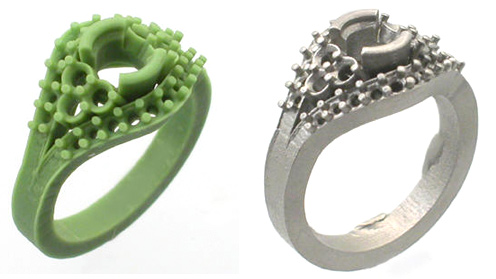
This article and video got me thinking of how 3D printing can, will and has changed the jewelry business. The flexibility that the computer aided design software gives is just incredible. Some hard to make intricate designs can now be easier to make. I took a look at the Solidscape T76 3D wax printer that is used in casting parts. The printed wax is used to make a cast. Turns out this is an elaborate five stage process, including the pouring of the molten metal into the cast, cooling and then polishing. The other way of printing jewelry is to use a printer that prints in metal. This process uses glue and a powder form of the metal. The glue and metal are printed in layers and then it is heated, then polished. This video that shows how GE is using 3D Metal printing to print newly designed parts for the aerospace industry. Imagine what you could design when prices come down on these printers.
Startups
The Great Packaging Presentation and The Crushed Product Fail
StandardOn Monday December 9th Allen and I attended the 14th NY Hardware Startup Meetup at NYC Alley. Disclaimer: MakeSimply is a sponsor of the NY Hardware Startup Meetup. It was a well attended event. There was not an empty seat in the house, It was standing room only. One of the presentations that stood out, for me, was one given by Ryan Vinyard from Lime Lab/Highway1. His presentation reminded me of an article I read awhile ago that described a first time hardware entrepreneur that had a packaging fail. It also reminded me of a presentation Allen and I gave at MakeIT NYC.
“Stacking one pallet on top of another crushed them”
He had a great Kickstarter. He met his goal and then some. The entrepreneur did not take into account the logistics, package labeling and kit packaging. These things are often forgotten. It is sad actually. You designed a great product. You worked very hard to find a factory. You shopped around the BOM. The product is coming off the assembly line. It passes quality control. You designed the packaging, but you left out the design of the kit packaging. This is where experts with import/export experience come in handy. They know what labels to use to place on the boxes so they are stacked properly. They know what packaging works best depending on method of transport of the product from point A to point B. They there is the amount of product per package that has to be calculated. Calculations are done on how many product will fit in the carton, how much will fit on a pallet and then how much will be in a container. Then there are these costs to consider:
- Container freight cost
- Packaging Cost
- Documentation handling cost
- Harbor Maintenance fee
- Fuel Surcharge
- Duty Cost
After you have calculated all of this, then you know how much your product costs to build and get to your customer. I would not recommend including shipping unless you have a deal with a shipper or fulfillment. If you don’t have an agreement you will be paying a lot more money for the shipping, taxes and tariffs if you are shipping internationally. Until next time.
Thanksgivukkah and Lean Hardware Startup
StandardDuring the holiday break I found this post on TechCrunch that then lead me to this post. Before I go on about these two posts from TechCrunch, happy Thanksgivukkah to those that celebrate Thanksgiving and Hanukkah. This year both holidays happened at the same time. This will not happen again for several thousand years.I hope you enjoyed the convergence. Now back to the posts. I struggle with how to communicate the hardware development process better to startups I talk to. The way I do it is through a sort of lean approach. There is Lean Startup and now there is Lean Hardware. We use these terms too when we describe the process. Our process is very similar to what is stated in the post, but we emphasize DFM throughout the entire process. Right from the start we think of DFM, we do not wait. We integrate it in as the processes are happening at the same time, in real time. Very much like the Thanksgivukkah Holiday convergence. We also iterate on the problem, communicating with the client throughout the process. Each step may need feedback and may need to explain why a feature may cost differently than another. Usually our clients have a price point in mine or price is not the overriding factor. Quality is. Their target market has requirements. Integrating in DFM is essential for saving time and money. Also while encouraging quality of materials and design.
My favorite quotes from the post are: “No hardware plan survives contact with a factory” and “Your factory is your most important partner”
The factory is truly a partner in the product development process. Do not treat them as a vendor. I can not say this enough. Yes, I think vendor is a dirty word. It describes a relationship that is distant and adversarial. The other day I was talking with a new prospective client. He was telling me how he hired someone to visit China, to visit factories and get quotes for his product. The product was not even ready to be quoted. It was not in the third stage of prototyping, it was in the second stage so the product was not in a finalized form. The BOM (Bill of Materials) was still changing. Not ready.
Three stages of prototyping
Stage 1-Ugly prototype: Just get it to work (MVP)
Stage 2-Design and Materials prototype
Stage 3-Finalized product design that is used to Design the Supply Chain (DSC) and the finalized BOM
So what happens when you go out and try to price a continuing changing target, you keep coming back asking for more information. This wastes both your time and the factories time. At the end, the factory will not want to deal with you. Or if they take you on you will not be on the top of the list of priority customers. We have seen this happen many times. The factory will get frustrated with the continued 20 questions game. Think of it this way, your product is not the only one the factory is being approached to build. Why should they take you on? Will you give them continued business in the future?
The right way to approach this is to meet with the partner and see if you get along well. Why do it this way? Well, because you are not getting into a short term business arrangement. This is not like going into a store, buying something of the shelf and then you are done. Everything is custom. When you get along with your partner things happen a lot easier. You might say you are building tacit knowledge in this arrangement. As one of my clients put it, we are married and we are in it for the long haul. There are capital risks that the factories take on, such as construction of the assembly line. The factories want to have partnerships that last a long time so they can justify the added costs. Most of my business partners past clients have been with them for 10 years plus. So, avoid being the lookie loo. You will piss them off. Be a partner instead. You will not regret it.
Why DFM?
StandardI had a meeting with a potential client last week (I meet with about 5-8 a week.). The product idea is interesting, but the methodology they are using to develop the product was all wrong. I suggested to him the way we do product development. As soon as possible we integrate in DFM (Design For Manufacturability). After the meeting, I received this article via email from another potential client. In brief, this article talks about why Kickstarter campaigns are delayed. Lack of DFM is one of the reasons.
Integrating in DFM (Design For Manufacturability) into the product development is key. Why? We receive product designs from customers that look awesome in SolidWorks, but can not be manufactured without alterations. This is a disappointment to them. On the bright side, the integration of DFM and design becomes a collaboration between the product designer, engineers and the customer. The collaboration does not stop there. When we start the tooling process we also collaborate. The factory is a key partner in this; they construct the tooling and assembly line for the client. It is too easy for customers to think that all they need is a design, and that is where their participation ends.
Manufacturing is a collaboration between clients, factory partners, product designers, engineers and project management.
The First Post
StandardI have been thinking what my first blog post would be about. Should I describe what this blog is about and why I am writing? First off reader beware, I am not a professional writer by any means. I am sure you will like what you read. What I do have, is the geeky love for all things hardware. So I will be writing about hardware and the hardware startup community in NYC (or where my travels lead me to. It will be hardware focused). I have lived through the software revolution now I am living through the new hardware revolution. I have had this love for these things ever since I was a child learning electronics on a HeathKit. Then taking apart my first remote control car (My parents were not happy about that). Then using it as a remote controlled alarm system or a secret decoder device. I spend many afternoons doing these things. I am sure you know of someone that have done the same thing.
The hardware startup trend is the combination of the physical and the virtual. As Brad Feld put it, “Software wrapped in plastic.” For me, there is a bit more happening here than just the intersection of hardware and software and the value only in the software. We are seeing an intersection of the physical world to technology in a much closer direct way than ever before. How can we combine these technologies in a way that will bring us value. The microcontroller processing power has gotten fast, cheap and easy to program. There are inexpensive tools to help you prototype such as the Makerbot, Arduino and Raspberry Pi. The excitement for me is in the endless amount of ways people are mixing these technologies together to help improve people’s lives and solve problems. Such as printing artificial limbs using 3D printers. Using sensors in the home to manage the environment. Using sensors to improve production in manufacturing. Using the technology to create wearables. New amazing products are coming out all the time. Yesterday a new product, called Coin was announced. The product is a substitute for carrying around all those credit cards. Registering of the credit card is done by using a square payment like card reader. Once your cards have been swiped and registered you use the hardware card, just like a credit card. Put all your questions aside about security and all (they address them in their FAQ), this is amazing problem solver for many people like me that have stuffed wallets. The device is just as thick as a credit card so it can be swiped at the credit card terminals. They have hit on a great problem to solve.
There are amazing products coming out all the time now, through a crowdfunding effort or presale such as Coin that take the technologies and use them in creative ways. During my week, I talk to at least four to five startups. Through these conversations I hear exciting stories of new products people are thinking of creating. People are finding creative ways to use the physical technologies to solve everyday problems.
There is excitement in the air about hardware in New York City. There are currently four meetups I know of (There could be more I don’t know about. Having four is incredible.) that formed to have conversations about hardware: MakeItNYC, The Hardware Startup Meetup (Full disclosure MakeSimply is a sponsor), Hardwired NYC, and Tech In Motion NYC (Covers topics about hardware). The attendance at each meetup is in the hundreds of people. If you know of other great meetups, please let me know. I love going to these. My info is on the MakeSimply home page. Select people scroll a little and then select your communications method.
Till next time.