The 15th NY Hardware Meetup and 16th MakeIt NYC Meetup Join Forces For a Blow Out Event!

15th NY Hardware Meetup a packed house
Standard

My how much the community has grown. The NY Hardware Meetup is at it’s 15th meetup. The MakeIt NYC is at it’s 16th meetup. All the meetups have been chock full of interesting stories coming from the trenches of the hardware scene in NYC. This one is no different except that the attendance was through the roof (see image above of standing room only crowd). By the way the back of the head in the foreground is Jonathan Hirschman organizer of the MakeIt NYC Meetup. If you wanted to know.

This event was a joint event between the NY Hardware Meetup and MakeIt NYC Meetup. Four entrepreneurs presented. After the announcements, next year predictions and sponsor pitches the audience was treated to some great startup stories.

Patrick Raymond presented his Curvit product and the two-year journey from it’s conception to national retail. Curvit solves one of life’s annoyances – it stops “shower cling”, and gives you more space for your daily spritz at the same time. Patrick is the founder of the Inventors Association of Manhattan, and he has hosted of Food Network’s Invention Hunters. It was great to see his progress and he started a Indiegogo campaign.

Coming off of their successful Dragon Innovation crowdfunding effort, Hammerhead Piet MorganLaurence Wattrus, and Raveen Beemsingh told the story of how they started. I wish I had a picture of the slide they showed of the iterations of their product. They started out in a apartment in New Jersey. LIving together, sharing space and creating a great product.  It was great to hear about their problems they faced and the direction they want to take the company. Motorcycle support is next! They are in the R/GA Connect Devices Accelerator.

Next up was Kurt Workman‘s and Jacob Colvin‘s story about their Owlet  product. The product takes baby monitoring to a whole new level. The Owlet Vital Monitor collects heart rate, oxygen and sleep data, and helps keep parents aware of possible indicators of danger. It was great to hear their story. As parents or would be parents themselves they were their own first customer. Their presentation was great and very warm feeling. Showing baby faces on the screen made people say awe.  They fielded questions expertly such as “What about the RF signal? Would cause the baby hard”. Their answer was two fold. They said that doctors say the risks out way the value you get from the information and how Bluetooth LE has at least 10 times less power then cellular RF. Their knowledge showed through. Way to go guys. They are also in the R/GA Connect Devices Accelerator.

Next and not least was Ben Melinger. He tells us two stories. The first one was about Smash Cup, a cool green, clean collapsible travel tumbler. I could use this product. I would make coffee at home and then take it with me. Clean it, collapse the cup and through it in my bag. Done. My bag is small so it would fit nicely collapsed. The other product story we heard was bout Fyll, a fashion-forward, tough glass water bottle that keeps water from being flavor enhanced (in a negative way) by plastic or metal flavors. Ben talked about his journey from beginner to pro. He gave the MakeSimply X Education program a shout out. Thx Ben. His story continued by discussing the hurdles he had to over come to get his products to the state they are today. One such hurdle was having to learn SolidWorks. For those that don’t know SolidWorks is a very popular CAD tool that is used to render complex solid 3D drawings and helps you move toward an engineering drawing.  The type of drawing that factories want to see. He discussed the huge cost of entry it is to buy this product. He wishes there was a cheaper solution out there that is just as popular. Thanks Ben for your great insights.

All in all it was a great event. We have defiantly outgrown that space. I can’t wait for the next meetup.

Disclaimer MakeSimply, a company I am co-founder of is co-sponsor of this event.

2014, The Year of Wearables and Hardware Startups

HP TC1100
Standard

Happy New Year everyone. There is nothing like a new year without predictions and statements about what is to come (or not) in your industry for the new year. So to start this year off right I have selected three articles to comment on for the new years blog post. I saw these articles during the holiday break. The first article is by Anthony Wing Kosner from Forbes online. I have come to read Forbes every now and then, but have become disturbed by their ads that interrupt and show up all the time.  I digress.   I agree with him that Hardware is the new Software. From the discussions I have had with people in the Hardware Community in NYC we all agree on this. When I talk with people about this I usually say that where we are now, with Hardware, we once was with Software in the 90’s. I feel it is like a blast from the past. During that time in our past, big companies were the only ones that could afford to make their own software. They had the funds to buy the servers and the software packages. Now look what has happened, startups can use development packages for free (open source) and they don’t need to buy servers they can rent time and use cloud services. Something similar is happening with Hardware Prototyping. Now you can use cheap development boards to prototype with. However, there is no foundation yet for the development of hardware products yet. Big companies have been doing this for awhile and so they have developed their strategies, but big company strategies do not translate to small company strategies.

We have project management techniques and Product Managers for software products, but not for hardware. Not yet. I see it happening and evolving in that direction. Hardware is very different than software (I have mentioned this and explained it in my other posts.) it needs a different kind of management and strategy. We are developing something along those lines at MakeSimply. That then leads me to the next article also from Forbes online by Rakesh Sharma. This article is a great start to the discussion of what makes a successful hardware business. It requires rethinking things and adapting new ways.  I also believe there are always was to streamline the process. Make the process open to the customer and easier to implement. The last article is a post to Google+ from Robert Scoble.  I mention it here as Google Glass is a new type of wearable hardware product. I am relieved to see that one of the biggest fans of the product has seemingly come to his senses and realizes that the product is not ready yet. I say exactly, that it is too early. It needs more time to cook. The ideas and use cases are solid, but the technology behind it is not ready. The battery does not last long enough, the processing power in the small package is not good enough and the OS is not easy to use. Not to mention the social implications of wearing such a device in public. This reminds me when Microsoft brought out the TabletPC. You can see the use cases, but the technology was not there yet. Also people were not shown the proper use cases that would make them buy the device. I also remember the head stares I would get when I showed up with my HP TC1100 TabletPC. Wow it was a wonderful device, the batter lasted for two hours or less, and it took forever for word to startup, but I loved the saucer separating machine (Star Trek Next Generation reference, look up HP TC1100 to further understand the reference).  It took almost six years after Microsoft came out with the TabletPC and until Apple came out with the iPad that technology and the market were in sync with each other. If Google Glass would come onto the market today it would be relegated to niche industries and will not be ready to be a consumer device. 2014 already looks like it will be a great year for Hardware Startups!

Printing Metal Jewelry

3D Printer Ring
Standard

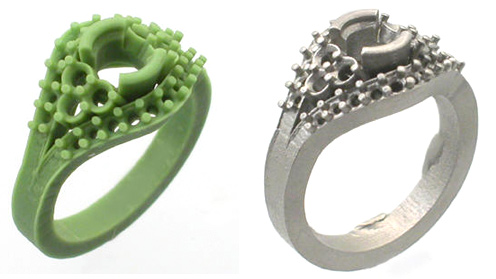
This article and video got me thinking of how 3D printing can, will and has changed the jewelry business. The flexibility that the computer aided design software gives is just incredible. Some hard to make intricate designs can now be easier to make. I took a look at the Solidscape T76 3D wax printer that is used in casting parts. The printed wax is used to make a cast. Turns out this is an elaborate five stage process, including the pouring of the molten metal into the cast, cooling and then polishing.  The other way of printing jewelry is to use a printer that prints in metal. This process uses glue and a powder form of the metal. The glue and metal are printed in layers and then it is heated, then polished. This video that shows how GE is using 3D Metal printing to print newly designed parts for the aerospace industry. Imagine what you could design when prices come down on these printers.

Thanksgivukkah and Lean Hardware Startup

THANKSGIVUKKAH
Standard

During the holiday break I found this post on TechCrunch that then lead me to this post.  Before I go on about these two posts from TechCrunch, happy Thanksgivukkah to those that celebrate Thanksgiving and Hanukkah. This year both holidays happened at the same time. This will not happen again for several thousand years.I hope you enjoyed the convergence. Now back to the posts. I struggle with how to communicate the hardware development process better to startups I talk to. The way I do it is through a sort of lean approach. There is Lean Startup and now there is Lean Hardware. We use these terms too when we describe the process. Our process is very similar to what is stated in the post, but we emphasize DFM throughout the entire process. Right from the start we think of DFM, we do not wait. We integrate it in as the processes are happening at the same time, in real time. Very much like the Thanksgivukkah Holiday convergence. We also iterate on the problem, communicating with the client throughout the process. Each step may need feedback and may need to explain why a feature may cost differently than another. Usually our clients have a price point in mine or price is not the overriding factor.  Quality is. Their target market has requirements.  Integrating in DFM is essential for saving time and money. Also while encouraging quality of materials and design.

My favorite quotes from the post are: “No hardware plan survives contact with a factory” and “Your factory is your most important partner”

The factory is truly a partner in the product development process. Do not treat them as a vendor. I can not say this enough. Yes, I think vendor is a dirty word. It describes a relationship that is distant and adversarial. The other day I was talking with a new prospective client. He was telling me how he hired someone to visit China, to visit factories and get quotes for his product. The product was not even ready to be quoted. It was not in the third stage of prototyping, it was in the second stage so the product was not in a finalized form. The BOM (Bill of Materials) was still changing. Not ready.

Three stages of prototyping
Stage 1-Ugly prototype: Just get it to work (MVP)
Stage 2-Design and Materials prototype
Stage 3-Finalized product design that is used to Design the Supply Chain (DSC) and the finalized BOM

So what happens when you go out and try to price a continuing changing target, you keep coming back asking for more information. This wastes both your time and the factories time. At the end, the factory will not want to deal with you. Or if they take you on you will not be on the top of the list of priority customers. We have seen this happen many times. The factory will get frustrated with the continued 20 questions game. Think of it this way, your product is not the only one the factory is being approached to build. Why should they take you on? Will you give them continued business in the future?

The right way to approach this is to meet with the partner and see if you get along well. Why do it this way?  Well, because you are not getting into a short term business arrangement. This is not like going into a store, buying something of the shelf and then you are done. Everything is custom. When you get along with your partner things happen a lot easier. You might say you are building tacit knowledge in this arrangement. As one of my clients put it, we are married and we are in it for the long haul. There are capital risks that the factories take on, such as construction of the assembly line. The factories want to have partnerships that last a long time so they can justify the added costs. Most of my business partners past clients have been with them for 10 years plus. So, avoid being the lookie loo. You will piss them off. Be a partner instead. You will not regret it.

Why DFM?

Designing for Manufacturability
Standard

I had a meeting with a potential client last week (I meet with about 5-8 a week.). The product idea is interesting, but the methodology they are using to develop the product was all wrong. I suggested to him the way we do product development. As soon as possible we integrate in DFM (Design For Manufacturability). After the meeting, I received this article via email from another potential client. In brief, this article talks about why Kickstarter campaigns are delayed. Lack of DFM is one of the reasons.

Integrating in DFM (Design For Manufacturability) into the product development is key. Why? We receive product designs from customers that look awesome in SolidWorks, but can not be manufactured without alterations. This is a disappointment to them. On the bright side, the integration of DFM and design becomes a collaboration between the product designer, engineers and the customer. The collaboration does not stop there. When we start the tooling process we also collaborate. The factory is a key partner in this; they construct the tooling and assembly line for the client. It is too easy for customers to think that all they need is a design, and that is where their participation ends.

Manufacturing is a collaboration between clients, factory partners, product designers, engineers and project management.