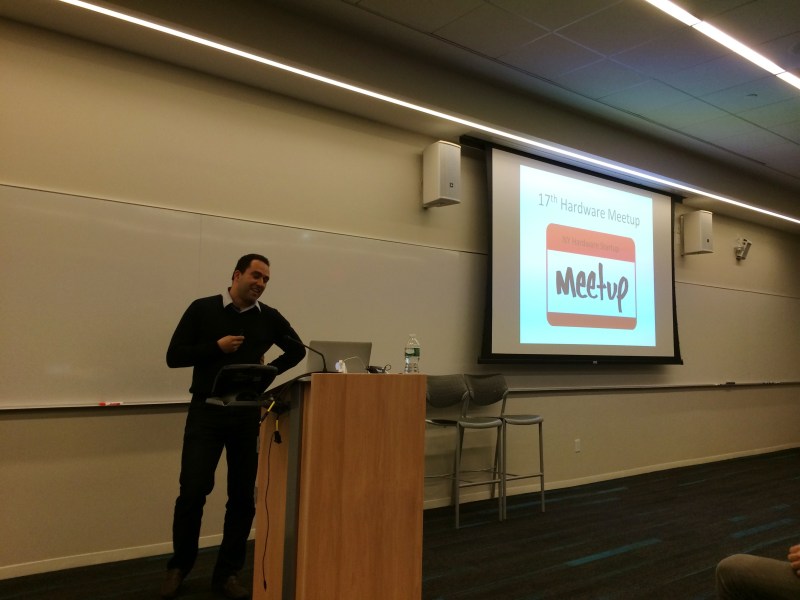
The 17th NY Hardware Meetup At the New Microsoft Space In Times Square

Hardware Meetup Organizer Haytham Elhawary
Standard

This month the meet up was at the new Microsoft corporate looking space. It was funny I walked in and thought about the times I worked at IBM. The space was huge. I would say that this space was at least three times the size when compared to the space at eBay. It was a welcomed relief not to be packed in like sardines.

Tom Kennedy (EnergyHub & Refactory) and Stephan von Muelhen (EnergyHub)

Tom Kennedy (EnergyHub & Refactory) and Stephan von Muelhen (EnergyHub)

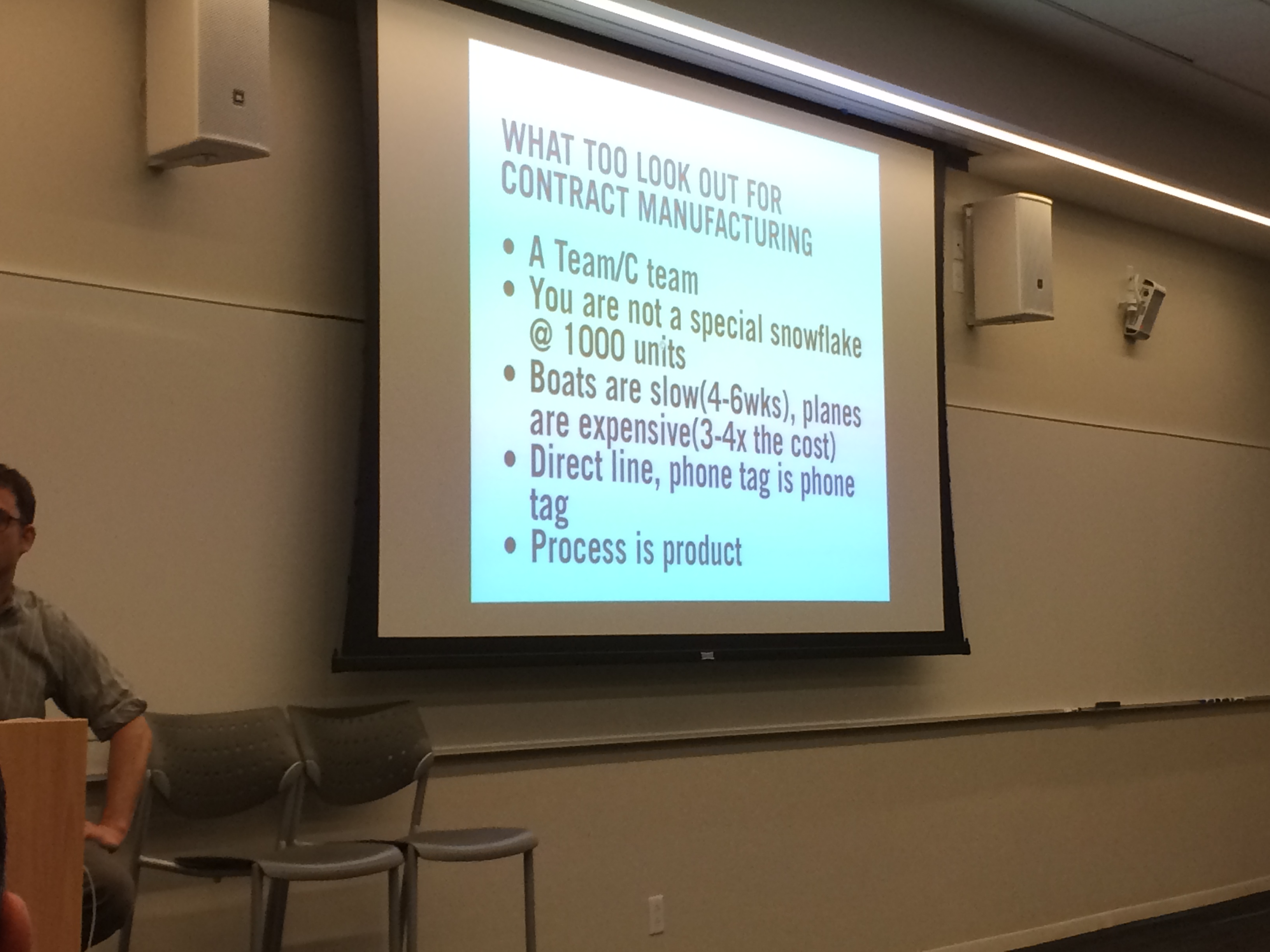
At this event we had two groups presenting. Tom Kennedy and Stephan von Muelhen first talked about their experiences at EnergyHub and what they learned a long the way about the manufacturing experience. They had some great pearls of wisdom that I totally agree with.

Tom Kennedy (EnergyHub & Refactory) and Stephan von Muelhen (EnergyHub)

Tom Kennedy (EnergyHub & Refactory) and Stephan von Muelhen (EnergyHub)

The line from one of their slides said it best for me, “Process is product”. There are a lot of details that need taken care of when you are manufacturing a product. There a thousand things that can go wrong at any given time. Developing a great product means that you know the process from end to end. I can’t tell you how many times I talk with startups that refuse to embrace what needs doing from start to finish. “Embrace The Horror”. This does means that you have an understanding of what needs to get done and realize that there are things that will come up that you may not of thought of. Actually for startups it is not a matter of if, but when it will happen. Since most startups are new to manufacturing and process in general.

Tom Kennedy (EnergyHub & Refactory) and Stephan von Muelhen (EnergyHub)

Tom Kennedy (EnergyHub & Refactory) and Stephan von Muelhen (EnergyHub)

Tom Kennedy introduced us to his next venture called ReFactory. So, in a nutshell, ReFactory wants to make the PCB/PCBA development and manufacturing process easy. They have many services ranging from design consulting to real PCBA. One main point is that the work is done in the USA in Brooklyn, New York.

Christina Mercando, founder of Ringly Presents

Christina Mercando, founder of Ringly Presents

The next presenter was the fab Christina Mercando, founder of Ringly. I have to say that the product is great looking. It looks high end and wearable. Men’s version? It was great to hear her prospective on bringing a fashionable product to market. I have talked to people who have studied this and they say we are at the infancy of this. I think that Ringly has done some great execution. There are many obstacles to get a product like this to market such as look, electronics and battery size. It just can’t be to big and the battery must last for most of the day. The radios have to penetrate the casing for charging and for Bluetooth. It seems they have solved these problems. The ring is big, but it goes with the styling. Congrats on the great execution.

That was the last presentation. Another one was schedule, but they called to cancel.

Check it out. I have more pictures of the event below. Sorry for the low light conditions, but you should make out the slides and the speakers ok. I did my best to caption the images and make adjustments to the images. Enjoy.

Are Wearables Over? | Fast Company | Business + Innovation

Link

A RECENT, WIDELY CIRCULATED STUDY FOUND THAT ONE-THIRD OF AMERICANS WHO BOUGHT A WEARABLE TECH PRODUCT DITCHED IT WITHIN SIX MONTHS. SO WHY ARE COMPANIES AS DIVERSE AS GOOGLE, NIKE, PEPSI, AND DISNEY PUMPING PLENTY OF CASH–AND NEW LIFE–INTO THE TECHNOLOGY.

I understand this trend first hand. I am in those numbers. I leave my Pebble Watch at home now-a-days. The notifications drove me nuts. The deluge of notifications made me realize there is a need for an intelligent layer that sits in between the torrent of data coming at us and the notification. I don’t want a notification about everything. I want it at a particular time and within a particular context. Not to mention the same information coming from multiple sources. I need information form the best sources with the most accurate information. Someone make this please.

Until then this is my smart watch:


Braun Digital Watch - bn0076

Braun Digital Watch – bn0076

via Are Wearables Over? | Fast Company | Business + Innovation.

Wireless charger can power 40 mobile phones at once from 15 feet away — Tech News and Analysis

Link

A team at the Korea Advanced Institute of Science and Technology recently demonstrated a new option for wireless charging: a nine-foot-long box packed with coils that can deliver power to up to 15 feet away with a magnetic field. The team debuted the system last week and in March used it to power equipment at a nuclear power plant.

Wait wait. Lets get this straight. They demonstrated awesome wireless charging using equipment at a nuclear power plant! Couldn’t they have just easily used an iPhone?  This would be a successful consumer feature.

via Wireless charger can power 40 mobile phones at once from 15 feet away — Tech News and Analysis.

New Material Coating Mimics Nature’s Lotus Effect via Pddnet.com

Link

Ever stop to consider why lotus plant leaves always look clean? The hydrophobic – water repelling – characteristic of the leaf, termed the “Lotus effect,” helps the plant survive in muddy swamps, repelling dirt, and producing beautiful flowers.

A natures way to a cleaning smartphone. 

Imagine having this on your cell phone. No more dirty cell phone.

via New Material Coating Mimics Nature’s Lotus Effect.

My Rediscovery of 3D Printing

My 3D Printer
Standard

I have been on a tear this week looking for information about 3D printers. I’m fascinated with the idea of printing things at home. So why not get a 3D printer?

Well for one thing they are not cheap the MakerBot 5th Generation sells for 2,899.00. That is not small change. My interest stated to justify this cost. I started reading more about this model.

3D printers need more finessing that you might expect. It is not as simple as sending a document to a regular printer then your text and graphics come on the page. With 3D printers you need to constantly tweak and fix.  This is not a bad thing if you have the time and love to do this. However if you are busy, like I am, it can get frustrating.

I have read online here and here about many issues with the new 5th generation MakerBot printers. Ugh I’m disappointed. Seems like they are not ready yet. The geek in me wants to get one now and the practical me says to wait. Luckily there is somewhat of a solution to my dilemma.

Last June I attended a build your own 3D printer class at Hack Manhattan. I was able to build myself a workable 3D printer called the PrintrBot Simple. The time is right for me to find it and get back into the flow of configuration and tuning.

Here is my baby 3D Printer:

WordPress is taking a long time processing the video so I uploaded it to youTube:

HeartBleed SSL flaw: Passwords Passwords and More Passwords; The Never Ending Amount of Passwords You Accumulate From Surfing The Web

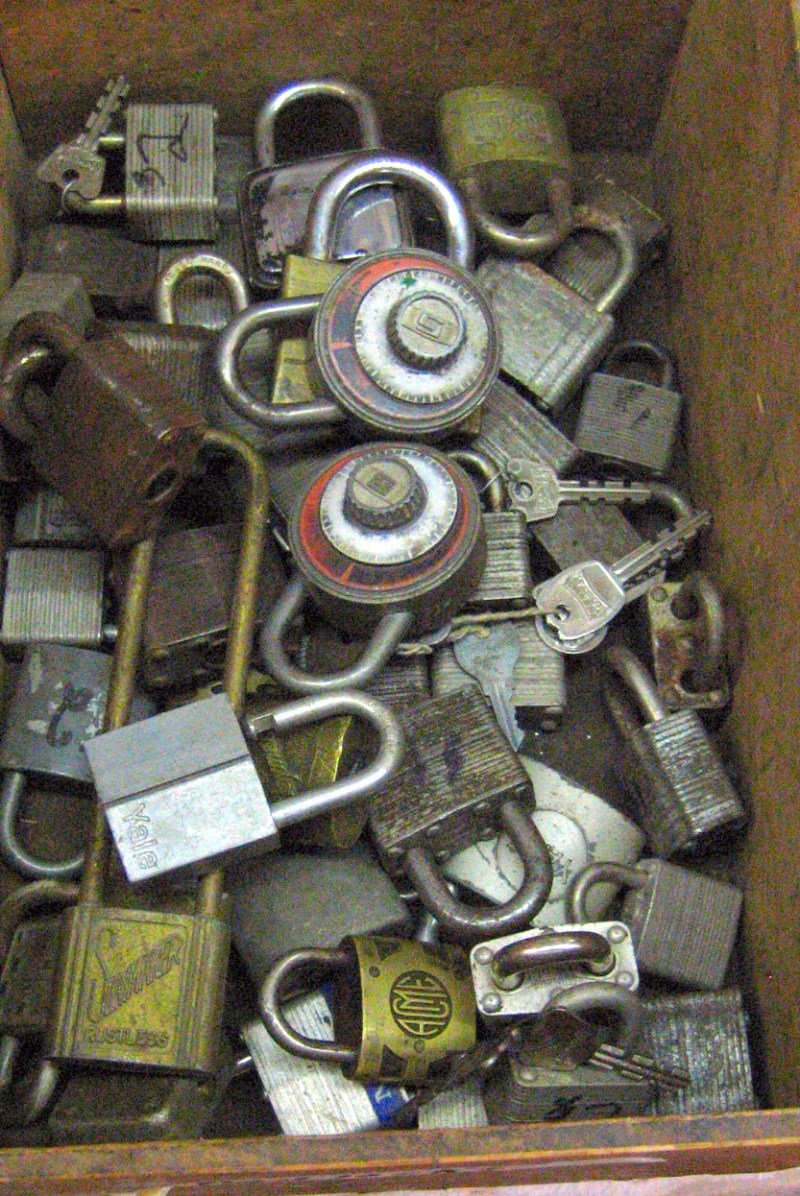
Locks In a Box
Standard

Everyone has probably, by now, heard of the HeartBleed SSL flaw. This flaw has been driving IT people and consumers crazy all week. IT people had to patch it and consumers had to try to wrap their heads around the idea what it is. In a nut shell from what I have read; wait till the website updates and then change your passwords. IT people had to patch and then get a new certificate. All of these things are not easy.

It has brought more attention to security, the use of passwords and password managers. I have over 200 passwords to keep track of. What tools are good to help organize them?

I have used SplashID for many years. It is ultra simple. It is a separate app that runs on your and your computer and you enter the information in there. If you like you can download the mobile app and synchronize them. So you can take your passwords on the go. The app is basic and I just coincidentally was looking for an app that had more integration with the web browser.

The first one I looked at was OnePassword. Since I was using another tool I wanted to import my large database of passwords in OnePassword. The import cause me headaches because it made most of the passwords unusable as notes. The other problem was that  you can’t more passwords from notes to another category. Scanning the forums I found that many people were not happy with this limitation and this was a downgrade from the earlier version. Earlier versions allowed you to change categories. This limitation left me with no choice, but redo all the records. Ugh no way. I am not doing that.

The next password manager I looked at is (I am now still testing it) LastPass. I like the idea of this tool. It goes several steps further than the rest and lives within the web browser. Just about any web browser. It has great security such as two factor authentication and I can change the categories. There is even a security checker that will go though your passwords and recommend you on the password strength and if that site was hacked and you should change your password. It has form fill in integration where it will enter my password for me. This is great as it should know the passwords better than I do. If you are and you should be using complex passwords it is a life saver when it autofills for you. There is not all joy here. I have had one or two glitches. One, it does not  always do the right thing when it autofills a form. I noticed that it sometimes will use my username twice instead of once and then the password. It has a feature where it realizes that you are changing your password and will update, but this has some flaws. Sometimes it creates duplicate records.

All in all none of these are perfect. So far LastPass balances out top be good for me for now. I suggest giving them a try to find one that works well with your work flow.

Photo credit: shannonpatrick17 / Foter / Creative Commons Attribution 2.0 Generic (CC BY 2.0)

The Age of The Digital Assistant Has Come. Too Soon? Is It Ready?

Cortana Lego Person
Standard

Microsoft announced their digital assistant, Cortana, on Wednesday. It looks like and sounds like Apple’s Siri.   While Microsoft has changed “What I can help you with?” to “Need Something?”. Google also has a digital assistant called Google Now.

I have used Siri off and on. More off than on. It seems like a toy than a workable product. Sometimes she understands me other times I am thinking she just gave up and is now ignoring me.

Google now seems more workable as it notifies you when you need information before you need it. Google Now is a responsible assistant. Siri needs activation to do something for you. Click and hold the iPhone home button and ask it for something. The voice recognition is not great. It needs more time to cook.

I want a digital assistant that would have two actions. One, I can ask it things I need to have done and it will do it. Two, it will know about me since it will have access to all my information on all my accounts and computers (including all mobile devices). The access I give to it given via an encrypted method. If the assistant runs into a problem I don’t want it leaking my information.  I would like the Cortona like assistant to create the information it gets while getting to know me kept in an encrypted area. What happens if the digital assistant becomes too intelligent and wants to become me. I would need a way to cut it off. That begs a question; How would you fire a digital assistant?

Are we ready for this? These Apple, Google and Microsoft are easing us into this very slowly. If we go too fast we would recoil about having a program having access to all our information. Taking privacy into account is a must.

In the future, where would these assistants live? I have given this some thought. Right now these entities live on your mobile device and on the provider’s servers. Eventually when network speed is not an issue I could see them swimming in the wakes of the global internet.  They could go from one network to another. That reminds of the movie Her. Unlike the movie I would not want it sentient. I would not want my assistant running off.

Photo credit: uubergeek / Foter / Creative Commons Attribution-NonCommercial 2.0 Generic (CC BY-NC 2.0)

A Process and a Plan

raja-gopuram
Standard

What does it mean to have a process and sticking to it? A repeatable business process or a process that works for what you are working on is like finding gold. I have been talking with startups that want to automate the hardware product development process. The scenarios run the gambit from automating the idea submission process, to just automating the PCB/PCBa, and then there is the ones that try to automate the process from idea to production.

The sentiment is very clear, people want to get rid of the human element or at least lessen the human effects. Such as; some people are hard to deal with or they don’t understand me or the best one yet – you don’t understand my business. All of these shouts in the crowd makes us seem antisocial. I believe that it is a collaboration between willing parties that produce the best work. The machines do not have the capabilities to act totally autonomously (for now) and with creativity. So when it comes to hardware product development you need both. There are just too many variables to automate.

The process approach works. It works like a well oiled machine and best yet it can be adjusted with feedback. Take this example I ran into all the time. The misunderstanding game. You schedule a meeting, but at the last minute the meeting changes from an in-person meeting to a conference call. Not a video call. Once the call starts you can hear on the other end the person click with the mouse and the keyboard. What are they doing over there? They are distracted. The call covers the topics discussed, but the key elements of the call. I will call this the understandings fall to the waist side. What has happened? Unknowingly without you paying attention the parties on the call don’t get it and the call was a waste of time. How often does this happen? Well in my time more times than none. So what I do is make sure you can see the person, at least at first. And this can be done easily now with the Google Hangouts or Skype. The face-time is essential for building trust and the relationship. After the sense of trust is there then the non-face-time tools will work much better and the understandings will not fall to the waist side. A personable approach just works.

Why is this part of the process and not assumed to be operational? That is because too many people are rush rush rush and too busy to know how to make a relationship. The relationship building is essential to the process. Once a sense of trust is there, even a little bit the rest will be simpler. Mistakes will not be the blame game, but a game of how do we fix it and come up with a creative way to solve the problem. Interwoven in the process is trust.

How could you then automate this in a computer? People have thought of various was to build trust or cred online. There is klout, linkedin, etc. However, we know that social media can be faked and the posts can be BS. Nothing new there. Before all of this people would BS on their resume and the only way to find out was to be a good interviewer or try the candidate out. Been there done that. Could you automate this? What would be a software solution for trust building? There is the recomendation engine solutions, but what happens if you are new to the site and you have none listed and you have many years with experience. What would be the online solution for trust?

Let’s experiment with a particular scenario – I am a hardware startup, I have a great idea, and I want to get my product idea to market. I have a limited number of skills. So let’s say that you are not very technical (You don’t know manufacturing) and you have made a software startup before. What is the process to use? Every step of the way you can get people to help. The things to watch out for is money, time and quality. Do you have the money to pay people, can you get people to help you for free or can you learn what you need to know yourself? How fast do you need to get this product out? If you say I need to sell this within a few weeks, you are crazy – That will never happen. The best thing to do is to research other products that are similar as yours. Research the business portions of your product idea for viability. That is right – Is it a viable product? There are methodologies out there to help you such as Lean Startup. Viability also means that you need to dive in and see who out there is doing what you want to do, what markets they and you want to be in and get a sense of the cost. The cost is not in the details yet but is important to know what the market would pay for your product.

Feasibility is the next step. Can this product idea be built? I have heard some crazy comments about this. Oh yes, everything can be done. However most people read that up to that point and then don’t read about the cost and time elements. Sure you can develop a new method of communication (for example), but what about the technology and what about the market acceptance? Is it too soon? Does the technology need more time to cook? By cook, I mean does it need more research and development. Did you pick a technology that no one is using or the only ones using it are the big players? For you to enter you need to be a big player. Startups that have reached this step tend to look at the future technologies and don’t put into account this. An example of this is that you want to use a screen technology that would make your product look gorgeous. You find a technology that is great, but very few people are using it and the players are big companies. What do you do here? You start out and create a version 1 of your product. The product does not use the new technology, but you can get a product out there that can be used and feedback gained. Or you can wait till the technology matures. If you are a large company with limited access to the technology then you can wait. You have the time and the money. For a startup, you need to get something out there so you can tell if the product is the right one for that market. It is best to know now before you spend a lot of time and money on the product. Look at it another way. You need to gauge the market and get data so you can understand the acceptance. Through the lifecycle of the product, you will have other versions of the product. This should not be your first and only one – how will you have a business with repeatable rents? So come up with version one. Call it the MVP or call it the beta product. Get the data and repeat.

Hardware product development takes time. You can tell from the latest crowdfunding campaigns that people have underestimated the duration and skills needed to deliver. Get someone that has done this before and ask their advice. Find out how similar products were made. What were their hiccups – Then put together your plan. Having a process and a plan will make you successful.

In future blog post, I will get more specific about how all this works. I have thought about creating a multipart post, but I have not thought that far yet. I need to get my writing process together and then create a plan.

Photo credit: Prabhu B Doss / Foter / CC BY-NC-ND

AnthroTech, Anthropology in Technology March 2014 Event About User Experience Research & Design

Museum of Anthropology, Vancouver
Standard

I went to the AnthroTech: Anthropology in Technology last night at the NYU Washington Square Campus. It was my first time going to this meetup. I thought it would be interesting so I went. As a user and builder of technology products (and a human) I thought it would be interesting to see how people at this meetup use anthropological methodologies to study the use of products. It is clear that studying humans is necessary for product development. How else are we find out how people use software or hardware products? Anthropology looks like it would mesh well with the other techniques we use today to do this. At this meeting the topic was “User Experience Research & Design”. The organizers took a great approach by including two aspects of UI/UX in two presentations. The talk was first about UI/UX in the context of software and then hardware. The hardware presentation was the one that I wanted to see. That is what I am doing now. Hardware product development.

Adam Nyhan one of the organizers of the AnthroTech Meetup

Adam Nyhan one of the organizers of the AnthroTech Meetup

The introductions of the presenters was done by Adam Nyhan one of the organizers of the event. He mentioned there would be wine after…I love wine. On with the show…

Jenifer Vandagriff Director of User Experience at F#

Jenifer Vandagriff Director of User Experience at F#

The first up was Jenifer Vandagriff Director of User Experience at F#. F# is a company that specializes in online advertising for music. They merge music, technology and advertising to help brands reach consumers. It is a great idea to combine the love of music and products. I have some friends that tell me they have their own theme songs. Jenifer walked us through their method. It is difficult for them to iterate on product when the ads (their product) have a short life span. I like the way they use measurement. The data feeds into their product development process. It provides them a way to react fast to the reactions people have to their adds. From what I see they use tools like Google Analytics, Facebook Stats and their own home-made tools. The process they use is pretty much standard for any software development shop today. I did not see much new here that I have not seen before.

Jessica Bates is Consumer Insights Analyst at Sony Electronics

Jessica Bates is Consumer Insights Analyst at Sony Electronics

The second and last presenter was Jessica Bates Consumer Insights Analyst at Sony Electronics. Before working at Sony she was a former Lecturer in Anthropology at San Diego State University. I was hoping to hear some insights into Anthropology and the product development process. Does it help or does it hurt the process? From her presentation it was clear that she was looking from the outside into the organization. I have been there before, as a consultant, many many times before. It has more pluses than minuses. The plus is that since you are looking from the outside in you see what people don’t see. Very valuable. The downside is that people may not know why you are there and you have to constantly remind people who you and what you do. Her presentation went through the product development life cycle in Sony. Most of which you can check out in the pictures below. Much to say that there were many avenues the processes could go through depending on management approval, budget and whatnot.  Sony is definitely not as agile as a startup and they do move slowly. I wonder is that an excuse anymore with all the information out there on how not to be slow and how to use innovation techniques to create new products and services. I remember Sony very lovingly from when I was a teenager use my water proof yellow Walkman (remember those?).  It is sad to me that it seems that they have fallen behind and are playing it safe. I am glad she walked us through the different ways they go through the process. It showed very clearly what gets in their way.

After the presentation I talked with her about the methodologies we teach in the NYU School of Engineering Management of Technology and Innovation. One of the techniques we teach is Outcome-Driven Innovation. (I should  do a word count on how many times I have used the word innovation. Ugh I bet it is way too many.) Outcome-Driven Innovation developed by Tony Ulwick and it studies the jobs-to-be-done. The method works and gives quantitative data that management can understand and use to make decisions about the value of developing a product (or adding/updating features to a product).

Check it out. I have more pictures of the event below. Enjoy.

Feature Image Photo credit: EarthOwned / Foter / CC BY-NC-SA The rest of the photos I took.

The 2014 Disney Accelerator Info Session in New York Powered By Techstars @ WeWork Soho West

Disney Accelerator Info Session - New York Techstars WeWork
Standard

Yesterday I attended the info session for the new Disney Accelerator powered by Techstars. The place was packed with people interested in the accelerator program. From what I hear the Techstars programs are very intense. A very good intense. The knowledge you get and the people (mentors) you meet in the program meets the gold standard.

David Min, Vice President of Strategic Business Innovation at Disney, and Cody Simms, Managing Director at Techstars presented. They talked about the program. They presented the program well and answered everyone’s questions. I will not give details of the program because you can read that in their website.

To the folks that apply to the accelerator I wish you much luck.

Check it out. I have more pictures of the event below. Enjoy.